The CNRS at VivaTech 2026: basic research central to technological sovereignty
Corporate
Innovation
| • For its 7th participation in VivaTech, the CNRS reaffirms its central role in deeptech innovation by presenting the groundbreaking advances that emerged from laboratories under its supervisory authority. • The CNRS will offer a wide range of programming at its stand in connection with major issues — ecological transition, cybersecurity & AI, industrial competitiveness — with a view to exploring, alongside scientists, entrepreneurs, and decision makers, how basic research contributes to French and European sovereignty. • The organisation will also be present at the gathering’s central events, with groundbreaking innovation in the fields of humanoid robotics and food. |
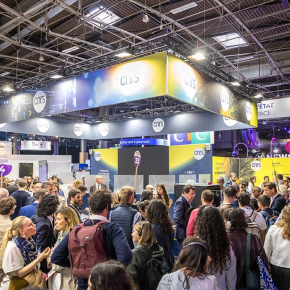
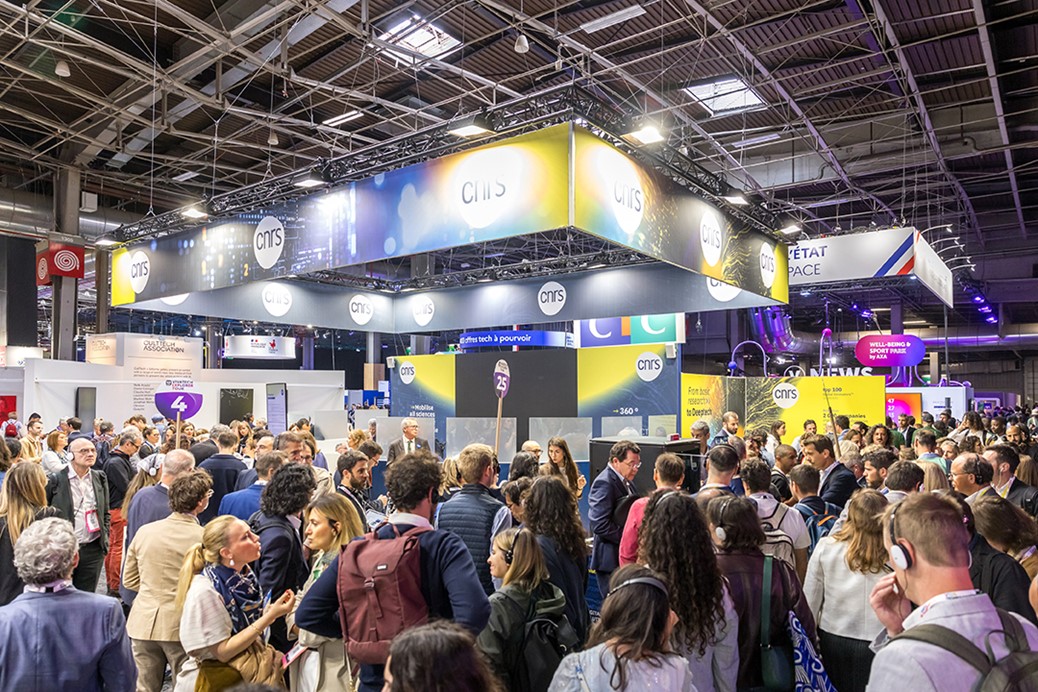
For the 10th edition of VivaTech, the CNRS will focus on technological sovereignty. From 17-20 June 2026, our stand will reveal how basic research — a source of deeptech innovation — has become a key lever for French sovereignty in three strategic fields: ecological transition, cybersecurity & AI, and industrial competitiveness. Over the course of three thematic days, the CNRS will bring together the scientific and industrial visions that make science a driver of both autonomy and technological resilience. The CNRS also invites you to attend the gathering’s central events to learn more about sovereignty-related issues in the fields of humanoid robotics and food.
For its 7th participation in the VivaTech gathering, the CNRS will present the depth of its commitment to French deeptech over the course of three thematic days. Ecological transition, cybersecurity & AI, and industrial competitiveness are all in keeping with national priorities, notably the France 2030 Plan, Priority Research Programmes and Equipments (PEPR) — 44 of which are led by the CNRS — and the 2026-2030 French National Cybersecurity Strategy.
A range of programming over the course of three thematic days
Each day actors from French innovation will share their scientific insights and expertise in economic issues as part of round-tables, conferences, and start-up pitches:
- Wednesday 17 June — Ecological Transition Day: this opening day will be devoted to the scientific and technological advances shaping an actual environmental transition — such as the renewal of energy systems and the production of sustainable and high-performance batteries — in addition to prospects for decarbonized industrial activity.
Speakers include: Frédéric Wurtz, CNRS researcher, Director of the Grenoble Electrical Engineering Laboratory1 , and leader of the Flextase project for the Energy Systems and Renewable Energies (TASE) PEPR - Thursday 18 June — Cybersecurity and AI Day: issues pertaining to cybersecurity and digital sovereignty — for which artificial intelligence has become a major factor — will be featured during this second day via exchanges and conferences on data protection, space security, and efforts to combat disinformation and to foster transparent artificial intelligence advances.
Speakers include: Francesca Musiani, CNRS researcher and Director of the Centre for Internet and Society2 . - Friday 19 June – Industrial Competitiveness Day: the programme for this last day will explore industrial competitiveness in artificial intelligence and technologies, the key role of electronics, and avenues for European cooperation to propel innovative start-ups.
Speakers include: Jean-Sébastien Tanzilli, CNRS researcher at the Nice Institute of Physics3 and Director of the Quantum PEPR.
The CNRS, incubator of groundbreaking innovation
The CNRS will present eight deeptech start-ups that grew out of laboratories under its supervisory authority, whose innovations address sovereignty-related issues.
The ecological transition
To address the environmental challenges raised by lithium batteries, two start-ups from CNRS laboratories offer complementary solutions for more sustainable energy:
- BeFC and its organic enzyme and paper battery that can convert sugar and oxygen into electricity;
- Entroview with its technology for real time diagnosis of lithium battery health, with a view to optimising the effectiveness of electric vehicles and renewable energy systems.
Ilion Water Technologies will present its innovative seawater desalination technologies. Based on the work of Lydéric Bocquet, a CNRS researcher4
and winner of the 2024 CNRS Innovation Medal, these solutions function via low-voltage electric fields, which are more efficient and environmentally friendly than high-pressure mechanical systems. Finally, Valame will reveal its chemical treatment solution for asbestos waste based on hydrochloric acid and the reuse of non-hazardous solid residues. This technology currently represents the only alternative to landfill disposal and plasma vitrification of materials containing asbestos.
AI and innovative technologies
In a context of increasing digital and information insecurity, the development of reliable technological infrastructure represents a central challenge. The start-up Xpdeep will exhibit next generation artificial intelligence that can explain itself and make its decisions transparent, traceable, and verifiable. This is an essential response to the opacity of traditional models, for a trustworthy AI in the service of strategic sectors.
The CNRS will also feature Exotrail, a start-up that is an expert in new space issues. Created in 2017, it develops “space buses” as well as innovative thrusters that can transport satellites from one orbit to another, all while providing safe and sustainable orbital mobility.
The CNRS will illustrate the dynamic technological creativity of its laboratories with two other examples of innovation. DIAMFAB offers semiconductors made from synthetic diamonds as an alternative to silicon carbide and gallium nitride. Produced from methane and hydrogen, this technology addresses growing needs in terms of performance, energy efficiency, compactness for power electronics, and decarbonized mobility. Clewtec, specialising in the transformation of matter into impregnable safes, will present its unfalsifiable physical signature technology that is integrated right from the manufacturing stage, combining 3D printable materials and advanced digital algorithms to offer an unmatched traceability and authentication solution.
The CNRS featured at VivaTech’s central events
Visit the Discovery Stage to learn more about two cutting-edge robotics and neurotechnology projects that emerged from laboratories under CNRS supervisory authority:
Neurathletics: science in the service of champions
Pushing back the physiological limits of sporting performance for elite athletes by strengthening their mental training, that is the goal of the Neurathletics start-up! Based on years of work by Camille Jeunet-Kelway, a CNRS researcher at the Aquitaine Institute for Cognitive and Integrative Neuroscience5
, this young start-up will demonstrate its technology based on the electrical modulation of the brain (neurofeedback) and brain learning.
Dynamograde: next generation humanoid robotics, from dynamic locomotion to advanced manipulation
Discover the future of European humanoid robotics thanks to a demonstration organised by the Dynamograde associated research laboratory, a collaboration between the Laboratory for Analysis and Architecture of Systems of the CNRS and the enterprise PAL-Robotics. The scientists will present two revolutionary platforms: Kangaroo, a high-performance biped humanoid capable of dynamic locomotion and high-precision environmental reactivity thanks to cutting-edge research in AI and reinforcement learning; and Tiagro Pro, a cutting-edge mobile manipulator with bimanual dexterity and force control, pushing back the limits of service robotics and human-robot collaboration.
The CNRS will also be present at VivaTech’s Business Redefined Arena on Wednesday 17 June at 14:30 as part of the round-table “Can AI promote food sovereignty, innovation, and decarbonization?”, with Mehdi Gmar, the CNRS Chief Innovation Officer, and Simon Bussy, the Chief Executive Officer of the start-up Califrais.
Finally, Eleni Diamanti, a CNRS computer scientists at LIP66 and the winner of the 2024 CNRS Innovation Medal, will speak on Thursday 18 June on the Purple Stage as part of the round-table “The quantum countdown: is your encryption already obsolete?”.
| Innovation at the CNRS today involves: • The creation each year of 80-100 start-ups emerging from laboratories under the supervisory authority of the CNRS, and over 1,600 active enterprises that grew out of laboratories under its supervisory authority. • Over 300 associated research laboratories between the CNRS and enterprises. • Over 500 new research contracts with enterprises each year. • 1st place in the ranking of European research organisations for the creation of spinouts (2025 Dealroom Ranking). • 1st place in the ranking of public research organisations for patent submissions in Europe (European Observatory on Patents 2025 Award). • 26 framework-agreements signed with public and industrial partners to develop contractual cooperations with CNRS laboratories. • Included in the 2025 Top 100 Global Innovators Report by Clarivate. |
- 1Under the joint supervisory authority of the CNRS and Université Grenoble Alpes.
- 2Under the supervisory authority of the CNRS.
- 3Under the joint supervisory authority of the CNRS and Université Côte d’Azur.
- 4At the ENS Physics Laboratory (CNRS/ENS-PSL/Sorbonne University/Université Paris-Cité).
- 5Under the joint supervisory authority of the CNRS and Bordeaux University.
- 6Under the joint supervisory authority of the CNRS and Sorbonne University.