
First absolute dating of Palaeolithic paintings in the Dordogne
Society
A research team led by a CNRS1
researcher has for the first time accurately determined the age of the cave paintings at Font-de-Gaume (Les Eyzies) in Dordogne (southwestern France), according to work published on 9 March 2026 in PNAS.
It had previously been impossible to precisely date the Palaeolithic cave art in the region, including that in Lascaux, using radiocarbon dating, as the paintings were believed to contain only iron and manganese oxides. However, no study had ever confirmed the absence of carbon.
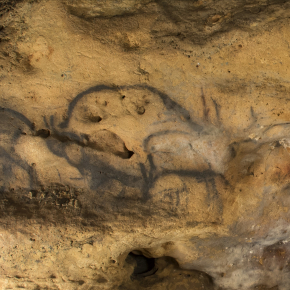
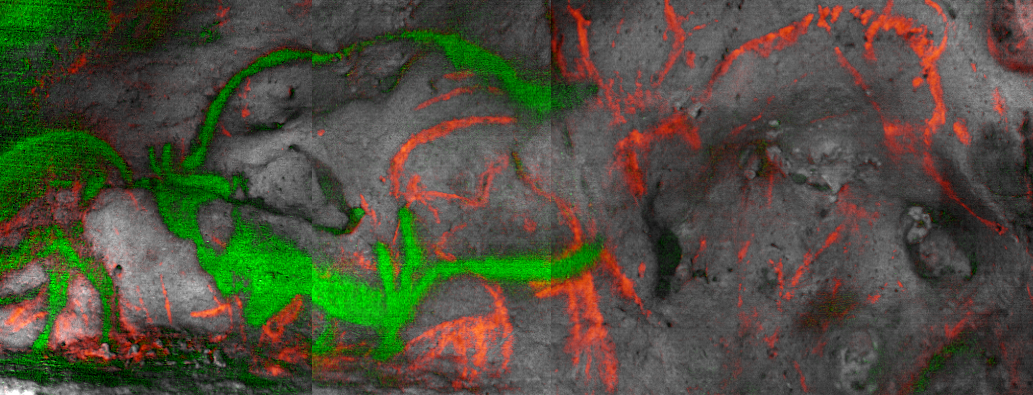
To carry out this verification, the scientists examined the chemical composition of two black drawings, depicting a bison and a mask, using Raman microspectrometry and hyperspectral imaging2 . These non-invasive methods revealed traces of charcoal in the black pigments. The uniform presence of charcoal throughout the black lines in the figures ruled out the possibility of contamination from graffiti or tourist activity in the cave. Collecting micro-samples was authorised on an exceptional basis for carbon 14 dating. Although this dating is challenging given the tiny amount of material, analyses confirmed a date in the Upper Palaeolithic, slightly more recent than previously estimated: the bison was painted between 13,461 and 13,162 calBP3 , while different parts of the mask were painted between 8,993 and 8,590 calBP, 15,981 and 15,121 calBP, and between 15,297 and 14,246 calBP.
Thanks to this new analytical methodology, the scientists hope to obtain accurate dating for other Palaeolithic figures, paving the way for a better understanding of cave art and the populations who created it.
- 1From the Laboratoire de développement instrumental et de méthodologies innovantes pour les biens culturels (Chimie ParisTech-PSL/CNRS/Ministère de la culture). Scientists from Laboratoire de mesure du carbone 14 (CEA/CNRS/IRD/ASNR/ Ministère de la Culture), national platform affiliated with Laboratoire des sciences du climat et de l’environnement (CEA/CNRS/ Université de Versailles Saint-Quentin-en-Yvelines), from the Histoire naturelle des Humanités préhistoriques laboratory (CNRS/MNHN/Université de Perpignan Via Domitia), from the Centre des monuments nationaux and the Centre de recherche et de restauration des musées de France also contributed to this work.
- 2Scientific imaging that measures the colour at each point and deduces the chemical composition of the coloured compounds present. This technique is widely used in the field of cultural heritage sciences, as well as in biomedical, agricultural, environmental and astrophysical research.
- 3Calibrated Before Present, conventionally set at 1950. This takes into account various factors such as variations in the atmospheric concentration of carbon 14, solar activity and the Earth's magnetic field.
Bibliography
Radiocarbon dating and chemical imaging of carbon black-based Paleolithic cave art in the Dordogne region (France). Ina Reiche, Lucile Beck, Ingrid Caffy, Yvan Coquinot, Matthias Alfeld, Anne Maigret, José Tapia, Marc Martinez, Anthony Lescale, Patrick Paillet. Proceedings of the National Academy of Sciences (PNAS), 9 March 2026.
DOI: https://doi.org/10.1073/pnas.2524751123