
Study reveals the diversity of early dogs
Life
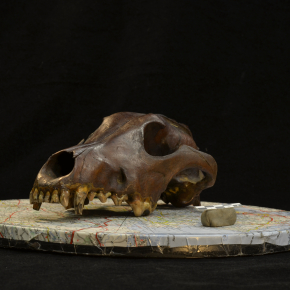
Dogs exhibited morphological differences from wolves around 11,000 B.C. Even at that time, there was a surprising range of variation among early dogs – long before the 19th century breeding practices that produced modern breeds. These findings come from an international research team led by a CNRS scientist11 . The study, published in Science on 13 November, sheds new light on the origins of domestication and offers fresh insight into the long and complex relationship between humans and dogs.
- 1 – Belonging to the Institute of Evolutionary Sciences of Montpellier (CNRS/IRD/University of Montpellier).
The conclusions are based on 3D analysis of 643 canine skulls from the last 50,000 years, found in North America, Europe and Asia. Using an innovative geometric morphometrics approach21 , the researchers were able to clearly distinguish prehistoric dogs from wolves, without relying on traits associated with modern breeds. The results show that by the beginning of the Holocene 10,000 years ago, dogs already displayed a degree of morphological diversity that likely reflects the wide range of roles they played in human societies2 (hunting, guarding, herding, and so on). By contrast, no canine skulls recognisably distinct from the wolf has until now been identified from the Upper Palaeolithic, the period during which domestication is thought to have begun.
Although the exact geographical origins and pathways of dog domestication remain difficult to trace due to extensive interaction among populations, this study offers major new insight into the early diversity of dogs. It suggests that their morphological diversification occurred both early and rapidly and opens the door to a re-assessment of the variety of roles played by these animals in prehistoric communities.
- 1Geometric morphometrics refers to a set of methods that allow for the precise quantification of skull shape variation and accurate comparison between specimens or groups
- 2The oldest identified specimen showing morphological characteristics of a dog comes from Siberia and dates back to around 11,000 years ago.
Bibliography
The emergence and diversification of dog morphology. Allowen Evin*, Carly Ameen*, Colline Brassard, Sophie Dennis, Ekaterina E. Antipina, Vincent Bonhomme, Myriam Boudadi-Maligne, Kate Britton, Francisco Gil Cano, Ruth F. Carden, Julien Claude,Lídia Colominas, Stefan Curth, Sergey Egorovich Fedorov, Daniela C. Kalthoff, Andrew C. Kitchener, Ricknecht, Pavel Kosintsev, Anna Linderholm, Robert Losey, Ilia Merts, Viktor Merts, Maria Mostadius, Mark Omura, Vedat Onar27, Alan K. Outram2, Joris Peters, André Rehazek, Erika Rosengren, Mikhail Sablin, Paul Sciulli, Maria Seguí, Z. Jack Tseng, Emma Usmanova, Victor Varfolomeev, Susan Crockford, Yaroslav Kuzmin, Laurent Frantz, Keith Dobney, Greger Larson, Science, 13 november 2025.
DOI : 10.1126/science.adt0995OI: