

In French Polynesia, research is supporting the energy transition
The CNRS, the University of French Polynesia and local stakeholders are working together to jointly develop innovations in ocean thermal energy and hydrogen systems. These are crucial for the country’s energy sovereignty and environmental ambitions.
The French overseas territories can always count on research to support their energy transition. “We’re stepping up a gear which is getting a lot of people on board,” states Gaston Tong Sang, the mayor of Bora Bora in French Polynesia and the country's former president. He is working with the CNRS and the University of French Polynesia (UPF) to make a success of the implementation of his island’s energy transition.
The energy transition is proving quite the challenge in France's overseas territories. These territories are often islands that are not connected to a wider electricity grid and so rely heavily on fossil fuel supplies that arrive by ship. This is the case of French Polynesia which is made up of 118 islands that are not interconnected and yet the country has set itself ambitious targets despite this, aiming for 75% of renewable energy in its electricity generation by 2030 as set out in its Multi-Annual Energy Plan (PPE).
The stakes are high. The first issue to be dealt with is the mitigatation of climate change, the effects of which include rising sea levels that are already submerging several Pacific islands. The second challenge is to resist potential price rises in the hydrocarbon market, which is also a core factor driving geopolitical tensions.
Science supporting the energy transition
Scientific research is playing a key role in addressing this challenge. The CNRS has created a research network (GDR)1 featuring a multidisciplinary research community to support this transition. This GDR, TranPolyn (Energy Transition in French Polynesia), is made up of researchers from CNRS and UPF laboratories with expertise in the disciplines of chemistry, materials science, engineering and systems science working alongside colleagues from the humanities and social sciences. They aim “to help French Polynesia achieve energy sovereignty and reduce its carbon footprint”, summarises Abdelilah Slaoui, head of the CNRS's Energy Unit and initiator of the Tranpolyn GDR.
The projects aim to provide the right responses to French Polynesia's specific requirements. One involves a marine thermal energy electricity generation system planned for Bora Bora which “works particularly well in French Polynesia where the surface waters are warm,” explains Abdelilah Slaoui. Scientists from the University of French Polynesia (UPF) and the CNRS are working with the French company Akuo on this system which has now moved beyond the prototype stage for the first time. The system harnesses the temperature difference between deep and surface waters to produce a constant supply of renewable electricity. The Akuo company conceived the project and is convinced of the value of the research. “We want to be clear and transparent about the technology’s impact on the environment so this is what the researchers are studying. This project is also a goldmine of information for basic and applied science, for example in terms of re-using the cold water drawn up which is pure and rich in nutrients,” explains Jean Ballandras, director of public affairs with Akuo.
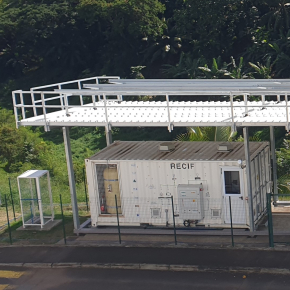
The Tranpolyn research network is also working on the development of another renewable electricity generation project in a modular format that particularly suits French Polynesia's many islands. This system looks something like a shipping container with solar panels covering the roof and a device inside that uses water and solar energy to produce hydrogen2 in response to local needs. “We've designed a complete system that improves energy production capacity and is adapted to Polynesia's very humid climate,” explains Abdelilah Slaoui. A demonstration unit capable of powering around five homes has been installed at the University of French Polynesia and now researchers are working on combining several modules to anticipate industrial requirements.
Integrating into the Polynesian context
To decide how to integrate these technologies into Polynesian social and cultural contexts the most effectively, “the GDR has opted to fully integrate the energy transition's social, cultural and political dimensions,” explains Camille Mazé-Lambrechts, CNRS research professor, member of the Tranpolyn GDR and holder of the overseas territories & global change chair at Sciences Po. Doing so involves understanding energy requirements on a per-island basis by taking French Polynesia's sacred sites and natural features into account and studying the relevant political and geostrategic dimensions.
Furthermore, the involvement of academic research make the search for funding for energy infrastructure easier. “This reassures our counterparts at the European level – it's an intellectual guarantee,” explains Gaston Tong Sang, the mayor of Bora Bora. “The Tranpolyn GDR is backed up by the CNRS’s expertise which also helps us obtain funding from the French National Research Agency,” adds Abdelilah Slaoui. The stated ambitions and structural constraints of such projects in France's overseas territories mean a significant level of funding is required.
These tailored solutions for French Polynesia “could be useful to a lot of other islands around the world who're facing the same challenges. We're working on joint funding applications with countries Australia, Fiji, New Zealand or Hawaii”, explains Abdelilah Slaoui. Now is the time to build on this momentum.
- 1Research groups (GDRs, groupement de recherche in French) bring together scientific communities to work on shared themes. These GDRs provide an ideal framework for exchange which in turn promotes the generation of knowledge.
- 2Hydrogen is stored in a tank and electricity can be generated via a fuel cell as needed.
The CNRS is reinforcing its links with French Polynesia
The CNRS already has links with French Polynesia through a framework agreement and maintains a presence in this region of the world through the CRIOBE1 laboratory. The organisation is continuing to expand its activities and has recently created a new research hub, Z’API in French Polynesia. The CNRS's long-term socio-ecological research sites, or zones ateliers, work on interdisciplinary research. Z’API is supported by a consortium of researchers working with civil society stakeholders to jointly design research capable of finding the right responses to the main environmental and societal challenges facing French Polynesia.
- 1The CRIOBE laboratory is dedicated to the study of coral reefs and is a research support unit under the supervisory authority of EPHE – PSL, Université Perpignan Via Domitia and the CNRS. It is based in Perpignan and French Polynesia, with a representative office in Paris.