Invasive species: improving the assessment of how they redefine ecosystems
Life
Although invasive alien species are very often reduced to predators eliminating defenseless prey, in reality they do more than simply weaken certain species: they fundamentally reshape the environment itself. In order to better assess the impacts of the roughly 3,500 invasive species on the environment, an international team of scientists led by a researcher from the CNRS1 has developed an evolution of the “Environmental Impact Classification of Alien Taxa ” (EICAT) standard. Introduced by the International union for the conservation of nature (IUCN) in 2020, EICAT had until now taken into account only seven of the 19 types of impacts identified by scientists. The team has therefore succeeded in integrating, for the first time, the twelve missing ecological impacts into the updated framework, EEICAT (for Extended EICAT). These results have been published in the journal PLOS Biology on March 10.
- 1Working at the laboratoire Ecologie, société, évolution (AgroParisTech Paris Saclay/CNRS/Université Paris-Saclay).
Unlike the previous system, which mainly focused on the direct effects experienced by native species (extinction or population decline), this upgrade of the framework is based on an assessment at three scales: the individual and population, the species and community, and the ecosystem and abiotic2 environment.
In addition to allowing the assessment of all 19 impact types, this evolution also allows to account for the same invasive species displaying different impact profiles depending on the invaded regions, thereby completing and refining the assessment.
It is now possible to diagnose each invaded ecosystem in a specific way, moving away from the single and incomplete representation previously offered by one single impact profile per invasive species globally. For example, this new framework makes it possible to prioritize the management of species that silently dismantle the physical processes underlying living systems without necessarily causing immediate extinctions, such as the Louisiana crayfish3 or the invasion of the tropical tree Moluccan albizia4 .
Since it is based on the same principle that the original EICAT, all previous assessment can be used, and completed with EEICAT. The scientists call on decision-makers to make use of EEICAT to facilitate the achievement of biodiversity targets such as the Kunming–Montreal Global Biodiversity Framework, adopted during COP15.
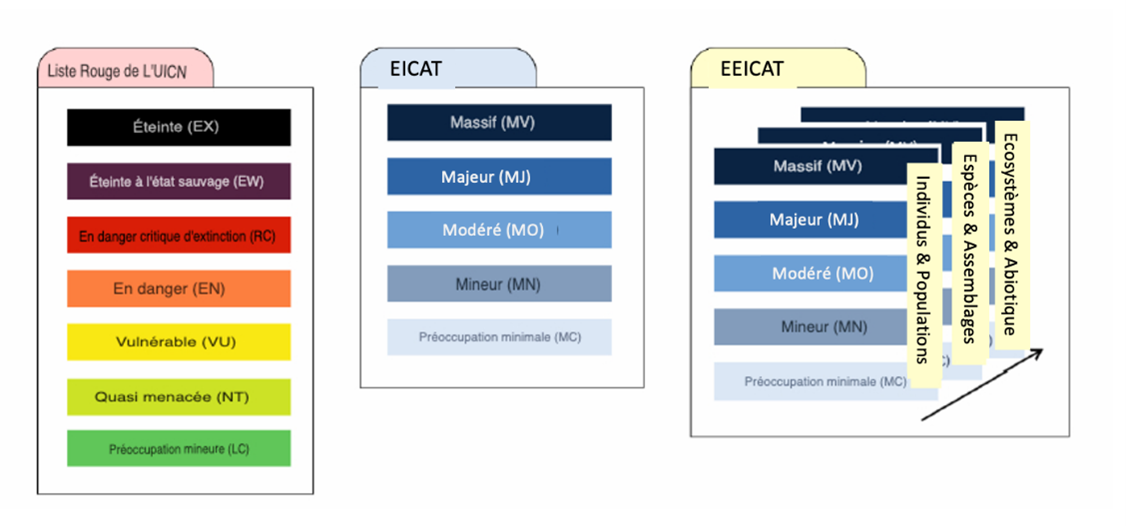
On the left: the liste rouge de l’UICN on which EICAT is based. In the center: presentation of the existing EICAT tool; on the right: presentation of the extension proposed by the scientific team.© Franck Courchamp
- 2Abiotic factors include the components that determine the physical environment of living organisms. These include, for example, soil composition, water quality, microclimate, fire regimes, etc.
- 3The Louisiana crayfish does not merely consume native prey; it also feeds on aquatic plants, thereby removing the very structure of the habitat and depriving fish of shelter. These invaders also fundamentally alter water quality.
- 4In nutrient-poor environments, this nitrogen-fixing tropical tree acts as a “chemical engineer.” With one of the fastest growth rates in the world, it modifies decomposition rates and the soil nitrogen cycle. As a result, the ecosystem shifts toward conditions that no longer support native plants adapted to a different soil chemistry.
Bibliography
Expanding invasive species impact assessments to the ecosystem level with EEICAT.
Laís Carneiro, Daniel Pincheira-Donoso, Boris Leroy, Sandro Bertolino, Morelia Camacho-Cervantes, Ross N Cuthbert, Alok Bang, Jane A Catford, Josie South, Steven J Cooke, Elena Angulo, Franck Courchamp. PLOS Biology, 10 March 2026.
https://journals.plos.org/plosbiology/article?id=10.1371/journal.pbio.3003665