Rendering opacity transparent through quantum entanglement
Matter
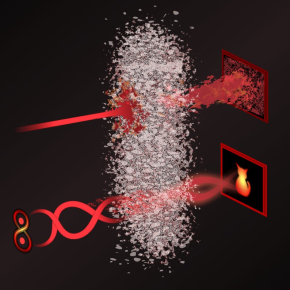
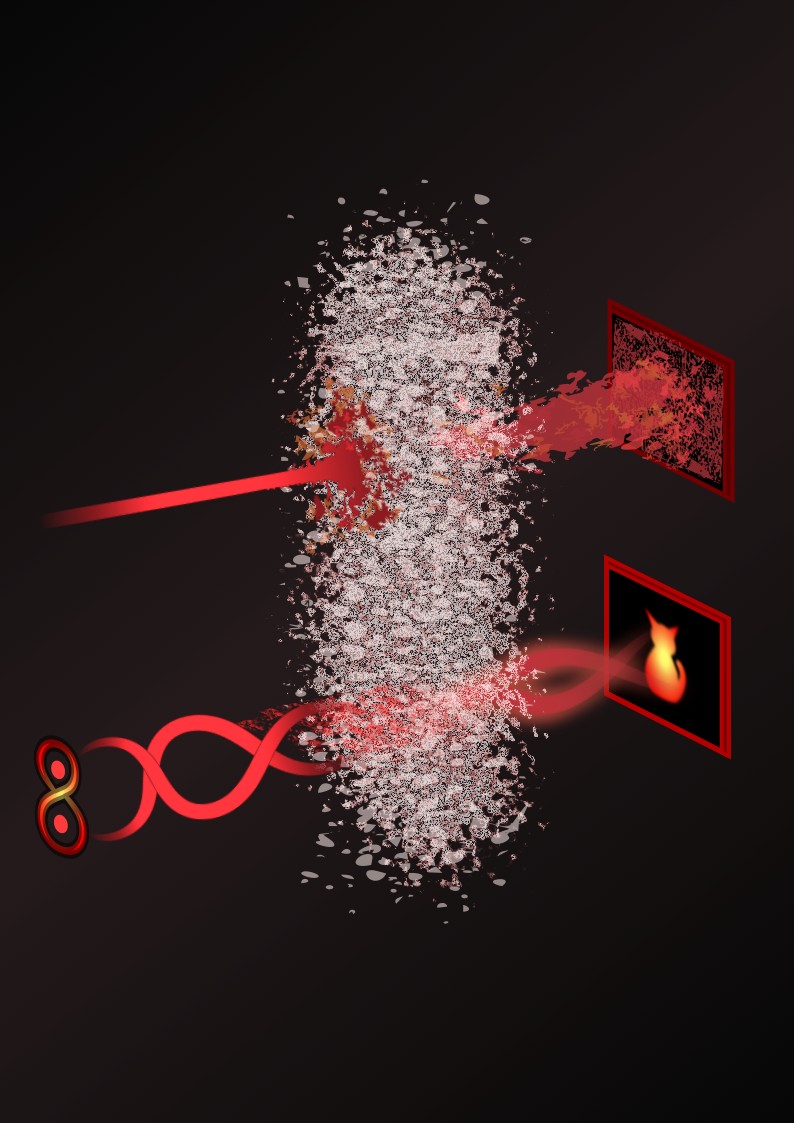
Using quantum entanglement to make opacity transparent, that is the feat achieved by a French team that includes a scientist from the CNRS1. Entangled photons possess a unique property: they form only one object, and the correlation they form between them conserves its coherence while crossing through disordered media. The image transmitted in this manner is preserved when it exits the medium, whereas classical light has its information systematically destroyed when subject to the same change. Entangled photons can therefore pass through scattering media, such as biological tissue or atmospheric disturbances, that would disperse classical light.
This discovery, recently published by the journal Nature Physics, sheds new light on a key issue in modern optics: transmitting information as faithfully as possible through all types of media.
The scientists used advanced techniques from quantum physics and optics2 to reveal this fascinating property, which marks a conceptual turning point, as complex media are no longer just obstacles to pass through. A smart and controllable opaque medium could be used as a filter to distinguish and separate classical information from quantum data.
This discovery could potentially have numerous and promising applications. In the field of secure communications, it could improve quantum cryptography protocols to avoid interference or hacking. In medical imaging, it paves the way for eventually being able to see through biological tissue without recourse to invasive methods.
Notes
- From the Paris Institute of Nanosciences (CNRS/Sorbonne Université). Scientists from the Kastler Brossel laboratory (CNRS/Sorbonne Université/Collège de France/ENS-PSL) also took part in this research.
- Techniques notably described in the article: Non-classical optimization of entangled photons through complex media. Baptiste Courme, Chloé Vernière, Malo Joly, Daniele Faccio, Sylvain Gigan and Hugo Defienne, Optica (2026), in which a team of scientists from the University of Glasgow (United Kingdom) is also involved.
Bibliography
Entanglement-enabled image transmission through complex media.
Chloé Vernière, Raphaël Guitter, Baptiste Courme et Hugo Defienne, Nature Physics, 19 May 2026.
DOI /10.1038/s41567-026-03265-9