

PEPRs - strengthening the voice of French science in Europe
PEPRs, the cornerstone of research that are financed by the France 2030 programme, are now entering debate on the European stages. In Brussels, the CNRS recently presented these structuring programmes as a lever to reinforce Europe's scientific sovereignty and articulate national priorities and the European research agenda more effectively.
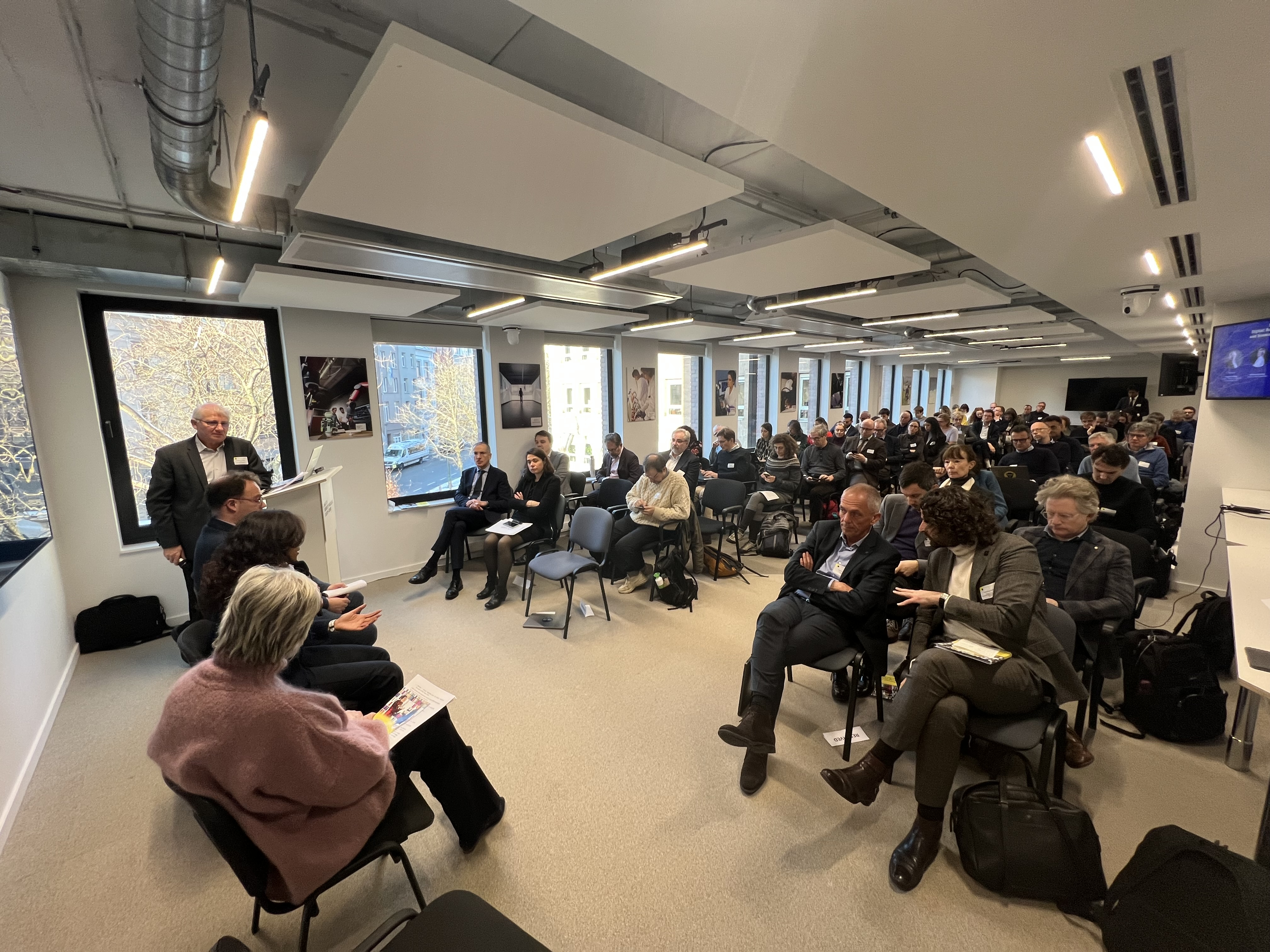
On January 6th in Brussels, the CNRS unveiled a tool that European institutions still knew too little about - the Priority Research Programmes and Equipment, or PEPRs. Many senior representatives of European research attended the event, including Jean-David Malo, Acting Director for ERA & Innovation (DG for Research and Innovation, European Commission) and Michiel Scheffer, President of the Board of the European Innovation Council, along with Cyril Piquemal, France's Deputy Permanent Representative to the European Union and around thirty directors of PPRs. The aim was to initiate direct exchanges between the people who define French research priorities and those who shape the European research agenda.
There are fifty active PEPRs funded with €3 billion in the framework of the France 2030 programme. These offer a scientific lever that is unique in Europe. Their structure comprises acceleration programmes (strategic sectors) and exploratory programmes (scientific breakthroughs) which means they can act simultaneously on basic research, innovation and societal applications. Finally, PEPRs structure interdisciplinary communities capable of providing a long-term (six to ten years of funding) transdisciplinary view of major scientific issues. France's leading research organisation, the CNRS, is directly involved in nearly forty of these PEPRs, either as the leader or co-leader.
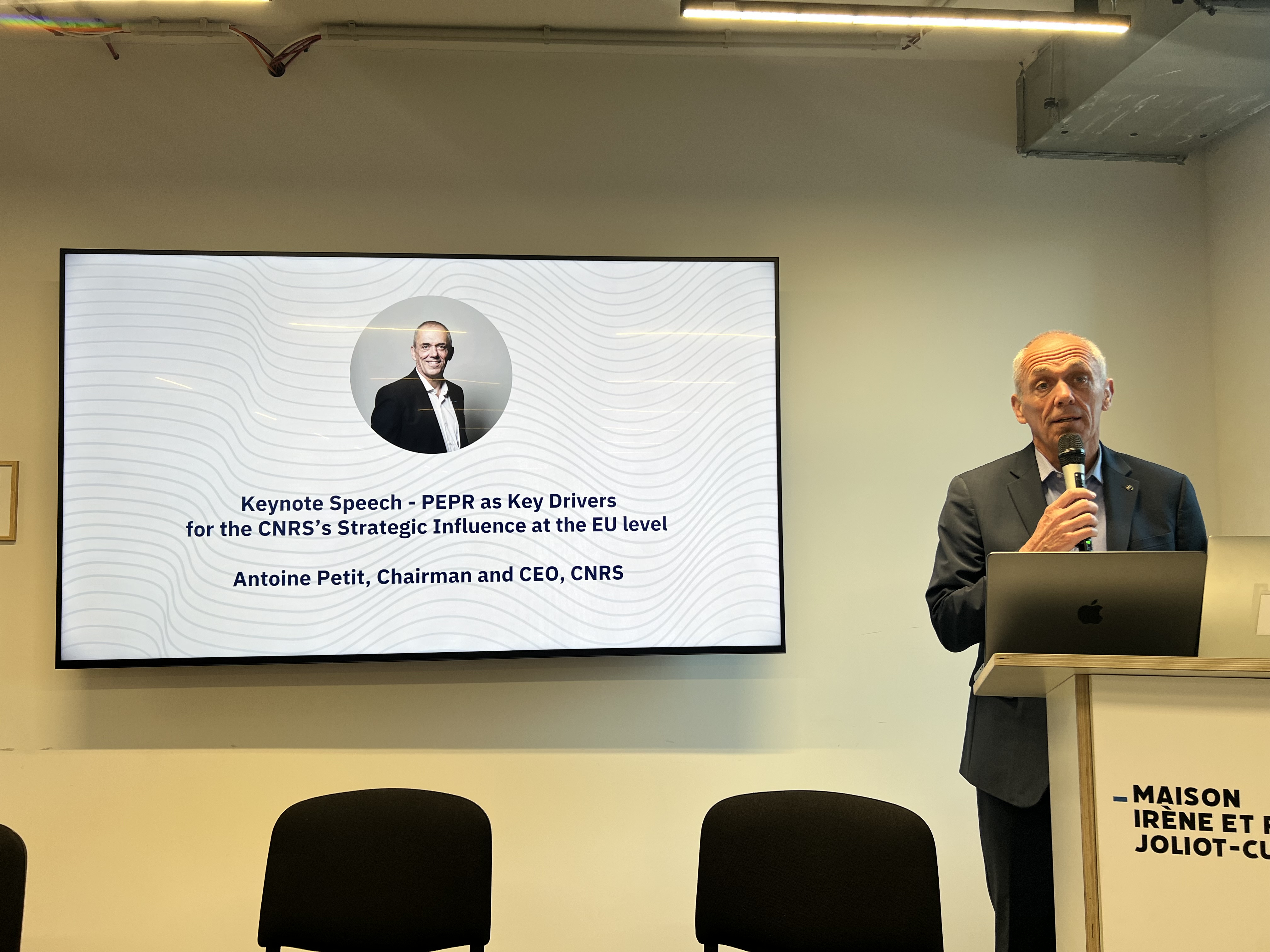
These priority programmes were designed to respond to French priorities but also naturally work on important European issues in line with the Green Deal, the strategic plan for energy technologies, the digital transition, health resilience and strategic autonomy. This form of positioning changes the equation, as Antoine Petit, Chairman and CEO of the CNRS, summarised thus: "Thanks to PEPRs, we're no longer content to simply take part in European research – we're now helping shape its priorities."
A structured response for the energy landscape
An initial round table on energy offered an immediate demonstration of the added value of these PEPRs. The energy transition is progressing under intense pressure in terms of the climate emergency, geopolitical dependencies and massive innovation needs. In this context, national strategies diverge while European priorities are rapidly changing.
With the PEPRs, France has developed a rare organisational structure in which the energy issue is segmented into operational areas like decarbonised hydrogen, batteries, recycling or advanced energy systems. Seven programmes are running in parallel, with each targeting a specific bottleneck while feeding into the work of the other PEPRS. This architecture means research can progress simultaneously on several technological fronts, whereas, in comparison, at the European scale research is viewed in more overall terms.

In this context, Philippe Froissard, unit director at the European Commission's Directorate-General for Research and Innovation, reminded those present of a known pitfall in this area. "We see projects that attain high maturity levels but are not yet ready for a mass roll-out. Often, what is lacking is the capacity to take the next step." PEPRS structure scientific communities over the long term and provide training in the required skills, thus helping to pave the way for the transition from research to roll-out. In this way, they are part of a process of technological anticipation.
Training the talent Europe needs
A second round table moderated by Frédéric Villiéras, director of the National Programmes Mission (MiPN) which coordinates PEPRs for the CNRS, highlighted the main obstacles to European digital sovereignty. While data, infrastructure, funding and talent are four inseparable pillars, attendees agreed that only one was considered truly critical. "If I had to choose one decisive factor for success in AI, I'd choose the human factor and the availability of talent," insisted David Arranz who is in charge of AI Strategy at the DG for Research and Innovation.
Again, France's PEPRs provide direct responses to this requirement by funding over 2000 PhD students and post-doctoral fellows, thus developing a pool of skills that can be mobilised immediately by public research, digital infrastructure and industry. This capacity for targeted training is a clear strategic advantage in a context in which Europe is actually struggling to recruit and retain the specialised profiles required to support and drive its technological ambitions,.
Moving from participation to co-construction
Finally, fragmentation remains a major issue, as Cyril Piquemal, France's Deputy Permanent Representative to the European Union, highlighted during a closing round table on strategic alignment between France and Europe. "Fragmentation is our enemy because it disperses resources and weakens our collective capacity." In a context of national initiatives, sovereign strategies and European calls, efforts and ideas can still tend to overlap which of course risks being counterproductive.
PEPRs provide a structural response to this issue by bringing together communities with critical mass, stabilising multi-year roadmaps and providing identified points of contact. In this way, they provide an effective framework for coordination that European mechanisms can sometimes have difficulty in establishing. This dynamic is already beginning to produce results.
PEPRs like DIADEM1 (materials) and TRACCS2 (climate) are integrated into European initiatives, while SPIN3 (semiconductors) provides an illustration of the complementary nature of between national and European funding. In 2024, PEPRs generated over €110 million in additional funding, including 41 winning ERC projects (European funding for excellence) which is a clear and strong indicator of their capacity to drive growth.
Finally, Michiel Scheffer, the President of the EIC, reiterated the importance of 'fast lane' mechanisms designed to speed up access to European funding for projects judged to have sufficient maturity in terms of innovation. The idea here is to facilitate the transition of innovations from the national to the European level.
A first step towards ongoing continuous dialogue
No new structures were unveiled at the Brussels meeting but the event confirmed that the existing PEPRs are both structured and operational. PEPRs also clearly prove that strong national organisation can become an asset for European coherency by providing stable communities, clear priorities and expertise that can be mobilised quickly.
These initial exchanges served to dispel a misunderstanding insofar as PEPRs were simply not very visible within the European landscape though present and functioning. Now that they have been identified by European institutions, they can become a tangible tool for aligning national ambitions and EU priorities. Their increasing prominence is also opening up a new space - a Europe of research co-constructed with France just when the next FP10 framework programme for 2028-2034 is beginning to take shape.
- 1 Development of innovative materials using artificial intelligence. This PEPR is led by the CNRS and the CEA and benefits from €85 million of funding
- 2 Transforming climate modelling for climate services. This PEPR is led by the CNRS and Météo-France and benefits from €51 million of funding
- 3SPINtronique, a PEPR led by the CNRS and the CEA, with €38 million in funding
Research – which way forward for Europe
Discover the CNRS series on the challenges of European research.