Crimean-Congo haemorrhagic fever: the mechanism for viral dissemination has been deciphered
Health
Life
Crimean-Congo haemorrhagic fever is an emerging disease with high epidemic potential that has been the subject of increased vigilance in France since 2023. Scientists from CNRS1 and Inserm have recently demonstrated a key mechanism that enables the virus causing the disease to disseminate within its human host. This discovery opens the way to repositioning drugs to target the metabolism in play, while underlining the need to develop specific treatments in anticipation of a possible epidemic. This study is published in Emerging Microbes & Infections on 30 March 2026.
Using virological and molecular biology approaches, the scientists discovered that the virus hijacks mechanisms in the liver related to lipid transport in order to assemble and disseminate new viral particles. In humans, the infection starts with flu-like symptoms but can then evolve towards severe haemorrhagic forms that are fatal in around 30% of cases.
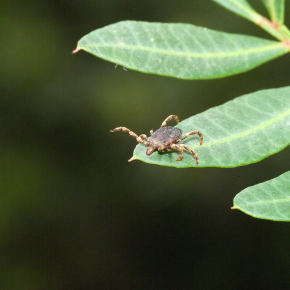
Until now mainly observed in Africa, Asia and some parts of Europe, the virus has recently been detected on Hyalomma2 ticks in southern France, at a time when the range of these ticks is spreading towards the north of the country under the effects of climate change. Although they currently do not offer specific treatment, some drugs used against lipid disorders such as hypercholesterolemia are displaying promising antiviral activity.
Notes
- Working at the Centre International de Recherche en Infectiologie (CNRS/ENS de Lyon/Inserm/Lyon 1 Université) and the Centre de Recherche en Cancérologie de Lyon (Centre de lutte contre le cancer Léon Bérard/CNRS/Inserm/ Lyon 1 Université).
- Hyalomma ticks are of large size and are heat-sensitive. They are parasites of cattle and a vector of human transmission for viruses such as Crimean-Congo haemorrhagic fever.
Bibliography
The Crimean-Congo hemorrhagic fever virus hijacks the liver lipid metabolic pathway for virion production. Anupriya Gautam, Li Zhong, Eva Ogire, Serguei Bodoirat, Ilary Riedmiller, Willem J Sander, Bertrand Boson, Apoorv Gandhi, Julien Burlaud-Gaillard, Fouzia Amirache, Vincent Legros, Philippe Roingeard, Vincent Lotteau, Cyrille Mathieu, Francois-Loïc Cosset, Solene Denolly. Emerging Microbes & Infections, 30 March 2026.
DOI : https://www.tandfonline.com/doi/full/10.1080/22221751.2026.2645855