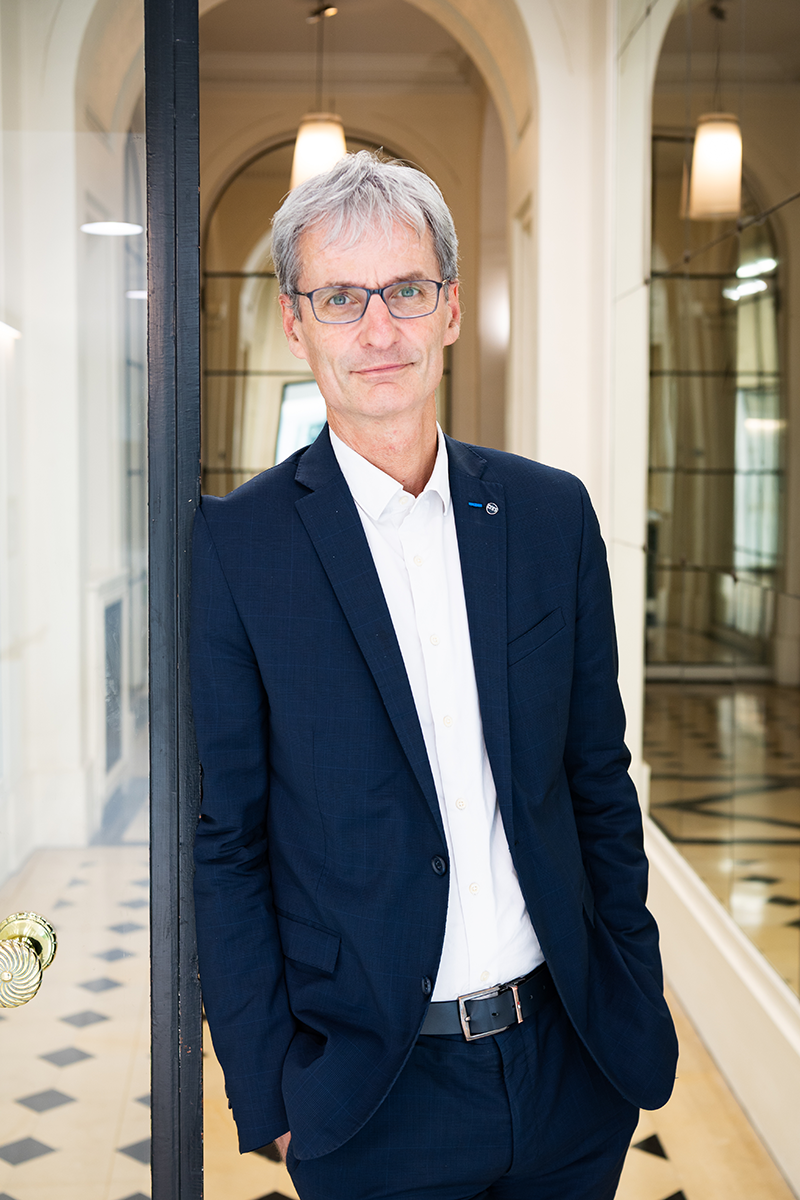
Thierry Dauxois is named Chairman & CEO of the CNRS
Corporate
Thierry Dauxois was named Chairman & CEO of the CNRS on 10 June 2026 by the French President Emmanuel Macron, on the recommendation of Philippe Baptiste, Minister of Higher Education, Research and Space. A physicist at the CNRS, Thierry Dauxois became head of CNRS Physics in July 2021, having previously acted as Vice-President for Research at the ENS in Lyon, from 2020 to 2021. He succeeds Antoine Petit, who was appointed in 2018.
“The CNRS is a remarkable institution whose mission has never been as essential. This is why I shall strive to give it room for action, in the service of an ambitious basic research that remains a prerequisite for our scientific sovereignty and our international influence,” Thierry Dauxois stresses.
The CNRS research professor Thierry Dauxois, who was born on 15 September 1967 in Toulouse (southwestern France), has devoted his research to nonlinear physics and statistical physics. He conducts his research at the Physics Laboratory (CNRS/ENS de Lyon), which he directed from 2012 to 2020. He then served as the Vice President for Research at the ENS (École Normale Supérieure) in Lyon from 2020 to 2021, before being appointed as the head of CNRS Physics. A member for the past five years of the Scientific Committee of the Parliamentary Office for Scientific and Technological Assessment (OPECST), he also acted as an auditor for the French Institute for Higher National Defence Studies (IHEDN) this year.
A former student of the ENS in Lyon and the holder of a doctorate in physics, Thierry Dauxois was recruited by the CNRS in 1994. His research career was internationally-oriented and geared towards collaboration. He completed long-term stays at the Los Alamos National Laboratory (United States), in Florence (Italy), and at the Scripps Institution of Oceanography in San Diego (United States). He was appointed a CNRS research professor in 2006, and from 2006 to 2010 directed the Phénix CNRS Research Network, which focuses on statistical physics and nonlinear physics. He then presided, from 2010 to 2012, over Section 02 of the National Committee for Scientific Research (Theoretical Physics: Methods, Models, and Applications).
His areas of expertise include nonlinear physics and statistical physics. He is a specialist of dynamical systems and chaos, along with the theoretical – and more recently the experimental aspects of waves. Early in his career, his research focused on nonlinear waves, especially solitons, of which tsunamis are an example. He took an interest in their characterisation, stability, and role in condensed matter, biophysics, and hydrodynamics. He more closely studied the link between statistical mechanics and nonlinear dynamics, especially the role of coherent structures in thermodynamics and dynamics. He then took a great interest in the statistical mechanics of systems with long range forces (gravitational systems, two-dimensional liquids, geophysics, plasma, etc.) by studying theoretical models, with special emphasis on a multidisciplinary approach.
His research activity has evolved over the past twenty years: in addition to conducting his theoretical work in statistical physics, he also became interested in the dynamics of density-stratified and/or rotating fluids (such as oceans), initially doing so analytically and later by way of experiments. He has published over one hundred scientific articles, and he has organised 18 international scientific symposia.