The CNRS, Lyon 1 University, and URGO are joining forces to create the wound care of the future
Health
Corporate
Innovation
| • The CNRS, Lyon 1 University, and the French family-owned enterprise URGO have combined their expertise to expand scientific knowledge and accelerate innovation for cutaneous fragility and chronic wounds. • The teams will work for six years to develop new treatments for chronic wounds such as leg ulcers, diabetic foot ulcers, and bedsores. |
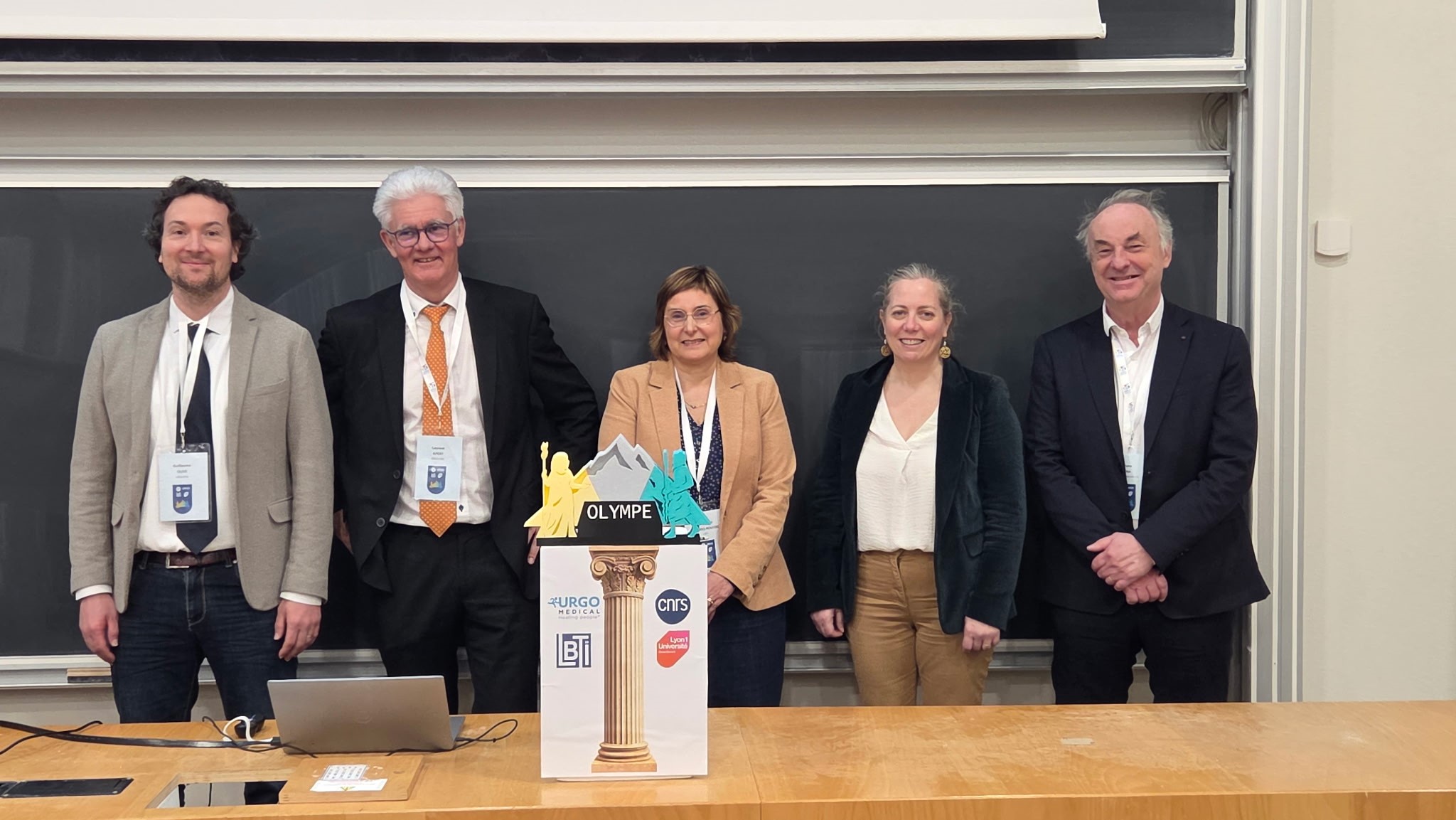
On 1 April 2026 the enterprise URGO, the CNRS, and Lyon 1 University inaugurated the Olympe associated research laboratory (LabCom), the first in France for preventing, treating, and healing chronic wounds. Nearly 40 researchers, clinicians, and engineers will collaborate for six years to accelerate our understanding of healing mechanisms, as well as the emergence of innovative therapeutic solutions. Olympe possesses unparalleled complementary expertise: the CNRS and Lyon 1 University, via the Laboratory of Tissue Biology and Therapeutic Engineering, provide their knowledge of biological tissue mechanisms, while URGO provides its expertise in the treatment of serious wounds.
A public health issue
In France, an estimated 2 million people1
suffer from a chronic wound, or approximately 3% of the population, a prevalence that could reach 2% of the global population, or 40 million people2
. These pathologies, which are often invisible, have a major impact on quality of life, independence, and healthcare costs. To contend with this major issue, the URGO group has joined forces with the CNRS and Lyon 1 University to address a high-profile scientific challenge: to better understand, prevent, and treat cutaneous fragility, in addition to chronic wounds of the skin and mucous membrane. This collaboration marks a change of scale in addressing these complex pathologies. For a period of six years, scientists from the pharmaceutical group will combine their skills and resources with those of teams from the Laboratory of Tissue Biology and Therapeutic Engineering (CNRS/ Lyon 1 University), experts in healthy and pathological tissue.
Understanding skin and its behaviour to improve treatment
At the intersection of biology, chemistry, bioinformatics, and engineering, this new collaboration will revolve around three major research focuses:
- Expanding knowledge on the functioning of biological tissue at all scales, including its environment and systems of fragility;
- Studying the tissue’s response capacity to physiological (including aging and inflammation management) and mechanical stress (pressure applied to the skin, tissue stretching from wounds);
- Improving existing therapeutic treatments and developing new, innovative approaches for care and prevention.
The research conducted at Olympe seeks to develop direct applications for patients, notably improved healing of leg ulcers; more effective treatment of bedsores and diabetic foot ulcers; and reduced healing time and complications, all resulting in improved quality of life for patients.
Consolidation of a long-standing collaboration between academic research and business
The Olympe LabCom grew out of a collaboration initiated over 15 years ago between URGO, the CNRS, and Lyon 1 University. This partnership has already advanced research on venous and diabetic foot ulcers, supported multiple theses, and generated scientific publications as well as patented innovations.
This cooperation is changing scale with Olympe. The laboratory will include nearly 40 people, and conduct up to six research projects per year, for a total of thirty during the duration of the programme. It also includes a training component to promote the emergence of new expertise on healing and regenerative medicine.
In the context of an aging population and rising chronic pathologies, this initiative represents an essential lever for fostering groundbreaking innovation, and for maintaining France among the world’s leaders in health research.
“The CNRS is thrilled by the creation of the OLYMPE associated research laboratory, a new step forward in a relation of great trust with the URGO group, built through numerous scientific collaborations since 2009. This LabCom, which includes Lyon 1 University and focuses on biological tissue and therapeutic solutions for cutaneous pathologies and healing, is a fine illustration of complementarity between public research and industrial innovation” indicates Mehdi Gmar, the CNRS Chief Innovation Officer.
“With OLYMPE, we’re taking things to the next level: by joining forces with the CNRS and Lyon 1 University, we’re creating the conditions to turn scientific breakthroughs into concrete solutions for patients. This collaboration allows us to move faster and deeper in our understanding of wound healing mechanisms, so we can better address the major challenge of wound care.
It builds on URGO’s longstanding commitment to research in France, driven by the conviction that therapeutic innovation arises from the dialogue between basic science, clinical expertise, and industry. With OLYMPE, we reaffirm our ambition: to develop, right here in France, the wound healing technologies that will shape the medicine of tomorrow” adds Guirec Le Lous, President at URGO Medical.
“The OLYMPE associated research laboratory demonstrates the ambition of Lyon 1 University to combine scientific excellence and industrial innovation in the service of patients. With regard to cutaneous pathologies, this partnership between the CNRS, Lyon 1, and Urgo strengthens the bond between research and concrete solutions. It is another key step in affirming Lyon as a leading international health centre” enthuses Bruno Lina, the President of Lyon 1 University.
Contact
Béatrice Dias
Presse Université Claude Bernard Lyon 1