The 2025 Innovation Medal: The CNRS reveals the four talents behind the advances of the future
Society
Innovation
Corporate
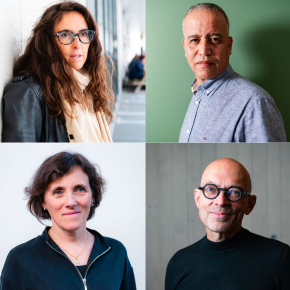
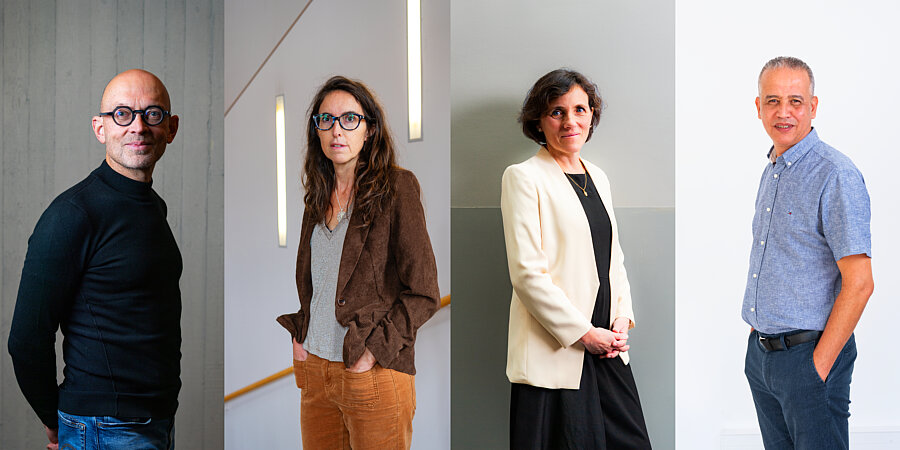
The 2025 CNRS Innovation Medal has been awarded to the linguist Alda Mari, the biologist Aziz Moqrich, the physicist Pascale Senellart, and the chemist Alain Wagner. Each year since 2011, the CNRS has rewarded researchers whose work has led to innovation addressing societal issues on the technological, economic, therapeutic, or social level.
The four winners received the award from Antoine Petit on 17 December 2025 at the Maison de la chimie.
The careers of the four 2025 CNRS Innovation Medal winners illustrate the excellence and variety of research conducted at the CNRS, as well as the crucial role of basic research in developing groundbreaking technology.
“We are delighted to award the 2025 Innovation Medal to four exceptional CNRS researchers who are also entrepreneurs. In fields as diverse as chemistry, biology, quantum technology, and semantics, they brilliantly transformed their discoveries into concrete innovations in the service of society. Their trajectory has inspired our entire community, and demonstrates how promoting and transferring research towards social and economic actors can be a genuine driver of progress. This award recognizes both their commitment and their results”, indicates Mehdi Gmar, the CNRS Chief Innovation Officer.
Alda Mari: Detecting emergencies on social media
Alda Mari, a CNRS Research Professor at l’Institut Jean Nicod (CNRS/EHESS/ENS-PSL), is a specialist in formal semantics. With dual training in classics (Greek, Latin, Sanskrit) and computational linguistics, for nearly fifteen years she has focused on the distinction between subjective and objective truth, and more specifically on the expression of bias and beliefs in situations of uncertainty. Her work is behind the flagship Phronesis programme, which in 2024 was instrumental in developing the HumanitiesPlus international research laboratory (CNRS/Université de Chicago). Beginning in 2017, Alda Mari applied these theoretical results to mental states and their linguistic expression in her research on hybrid AI. She notably developed a new methodology to identify and classify urgent information during environmental crises on social media. This methodology was implemented in INTACT (Detecting Intentions, Predicting Actions) software, a technology developed in collaboration with the Toulouse Research Institute in Information Technology (CNRS/Toulouse INP/Université de Toulouse EPE), with support from the Ministry of the Interior. Based on a linguistic model that takes full account of utterances, INTACT offers high potential for application to other types of crises, especially the information-related ones currently being studied by Alda Mari.
Aziz Moqrich: Unraveling the enigma of chronic pain
For millions of people living with chronic pain, effective relief often comes at a high cost: dependency, tolerance, and severe side effects. But what if pain could be treated without these risks? This is the question driving the work of Aziz Moqrich; a CNRS research Director at the Marseille Developmental Biology Institute (Aix-Marseille Université/CNRS). Moqrich’s scientific journey has always been motivated by understanding how acute pain develops into chronic pain. To develop an alternative to opioids, which remain the most effective molecules for treating pain, the researcher pursued a different avenue: the protein TAFA4. This molecule, which was identified in 2007, is endowed with a powerful pain relief effect. In 2020, Aziz Moqrich co-founded the start-up Tafalgie Therapeutics to develop a new analgesic drug based on peptide derivatives of TAFA4. The initial data from clinical trials among healthy volunteers shows an excellent safety profile, clearing the way for trials in surgical patients. with a view to assessing the antalgic effect of these peptides. The first results are expected in 2026.
Pascale Senellart: On the road to the quantum computer
The research conducted by Pascale Senellart, a CNRS Research Professor at the Centre for Nanosciences and Nanotechnologies (CNRS/Université Paris-Saclay), focuses on photons, the elementary quantum entities that make up light, as well as “quantum dots,” nanostructures that can generate them on demand. By controlling the emission of quantum dots, in 2013 her team created new sources that very efficiently emit single photons in a precise direction, thereby enabling their manipulation within photonic circuits. Her research and the resulting innovations have paved the way for using photons in quantum computing, one of the four pillars of quantum technology. Indeed, photons are excellent systems for encoding quantum bits–or qubits–the basic unit of information for quantum computers. To make their single-photon sources accessible to the scientific community, Senellart and her colleagues Niccolo Somaschi and Valérian Giesz founded the start-up Quandela in 2017. From 2020 onwards, Quandela moved in a new direction: building their own photonic quantum computers by jointly developing the hardware and software. In 2024, Quandela delivered Lucy–the most powerful photonic quantum computer housed in the CEA computing center.
Alain Wagner: Chemistry in the service of living beings
Alain Wagner, a CNRS researcher at the Strasbourg Laboratory of Synthetic and Therapeutic Chemobiology (CNRS/Université de Strasbourg), develops new approaches to better understand and modify biological systems. He and the Biofunctional Chemistry team he leads have been focusing since 2010 on antibody-drug conjugates (ADCs), vectors that can destroy cancerous cells and increase the life expectancy of patients. To transfer these research results towards industry, in 2014 Alain Wagner co-founded Syndivia, a biotechnology start-up that develops ADCs that are better tolerated and have fewer side effects. He was also behind the creation of the start-up NovAliX in 2002, which specializes in discovering new drugs, and Phytodia in 2007, which develops plant-based ingredients for food supplements and cosmetics. More recently, he co-founded MicroOmix, a start-up that analyses the antibodies secreted by each cell, thereby paving the way for developing new antibody-based therapies.
Ressources :
Videos essays : Alda Mari, Aziz Moqrich, Pascale Senellart, Alain Wagner
CNRS Le Journal : Les nouveaux visages de l'innovation | CNRS Le journal (French only)